
My Body Knew What My Head Did Not
I want to tell you about the night I played with imaginary machine guns on a Zoom call — and how two days later, a pain that had been bothering me for months was gone.
I was in an evening group Zoom class with David Bedrick. He asked us to scan our bodies and notice if anything was present.
I had a pain in my right hip. It had been bugging me for a few months. So I brought my attention there.
He asked us to notice any images or metaphors that came up. Instantly I saw an image of: guns.
I was about to dismiss it entirely. That makes no sense. That's ridiculous. But David said — almost like he knew, "It might seem strange, but go with it."
My camera was off. So I did.
I started with tiny guns. Then he said, "Make it bigger!" and they turned into machine guns. I used my hands, my body, made the sounds with my mouth. I thought, if anyone saw me right now they'd think I've completely lost my mind.
Two days later I was sitting on a church bench at a funeral. I felt oddly at peace. Very content. I sat there for a moment wondering what was different.
Then I realized I was out of pain.
"The body is the unconscious." Dr. Eugene Gendlin said this in the 1970s.
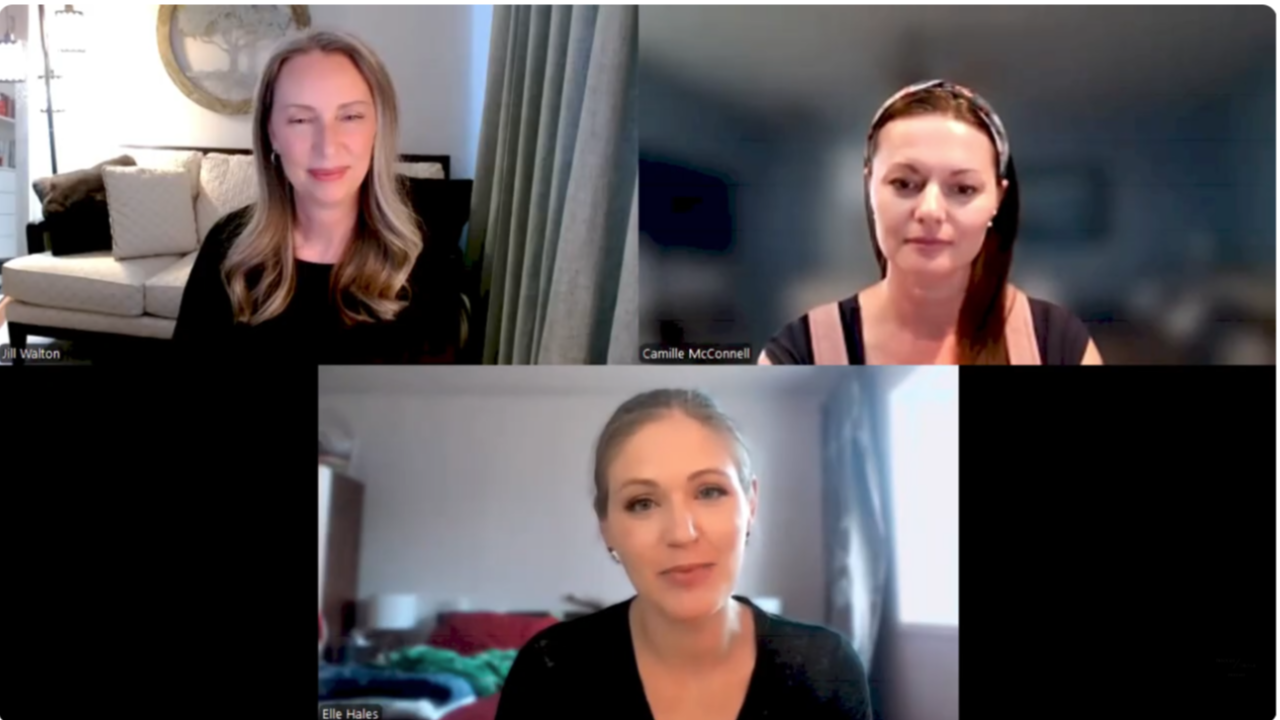
That's a phrase I've been sitting with for a while now, and one I talked about recently on the Through the Veil podcast with Elle Hales and Camille McConnell.
The body knows what the head does not.
Most of us have been trained to do the opposite — to start with our thinking, to analyze the problem, to understand our way to healing. And understanding has real value. I'm not dismissing it.
But there's a ceiling to what the analytical mind can access. Because some of what we're carrying doesn't live in language. It lives in sensation, in image, in metaphor, in the strange and irrational and sometimes slightly ridiculous things the body wants to express.
The pain in my hip wasn't a structural problem. It was something that needed to move — something that had been held, compressed, waiting for permission to be expressed. The machine guns weren't random. They were the image my body chose to communicate something my head would have overthought into paralysis.
This is what a bottom-up approach to healing means. Instead of starting with the story, what happened, why it happened, what it means, you start with the body. You ask: what's here? What does it feel like? What image comes? And then you follow that, even when it seems strange. Especially when it seems strange.
The body is not confused. The body is not dramatic. The body is the most direct route to what actually needs attention and expression.
I've been doing this kind of work helping people listen to what their body is already trying to say for nearly 20 years. It's the foundation of everything I do with clients, whether we're working with Focusing, Integrative Change Work, or the energy-based modalities.
The conversation I had with Elle and Camille on Through the Veil goes deeper into this — what it actually looks like to stop analyzing and start listening, and why the body is often so far ahead of the mind.
You can watch it here: https://youtu.be/7WXhQlKjPlY?si=gw_r8FwwqTnhC05W
And if something in this landed — if you've been carrying something your head can't quite reach — I'd love to work with you. Summer sessions are open: Schedule Here!
If something here landed — there's more. Weekly stories on nervous system patterns and coming home to yourself.
Author

Jill Walton
Life Coach · Nervous System Specialist · Integrative Change Work Practitioner · Emotion, Body & Belief Code Certified
I've helped people shift the patterns that talk therapy alone couldn't touch. The work happens in the body — and that's exactly where I work.
